Dark Matter - The Nova Incident, Part 5: The First Move Falls to Us
A probe leaves Troy 39. Captain Fermi makes a decision that cannot be undone.
📖 This story takes place shortly before the events of Dark Matter Book 1.
Start the journey with Chapter 1 on Substack or read the complete novel on Amazon (Kindle, Paperback or Hardcover).
⏳ Part 5 of 6 of the prequel arc.
🍿 A short video edition brings this chapter life here.
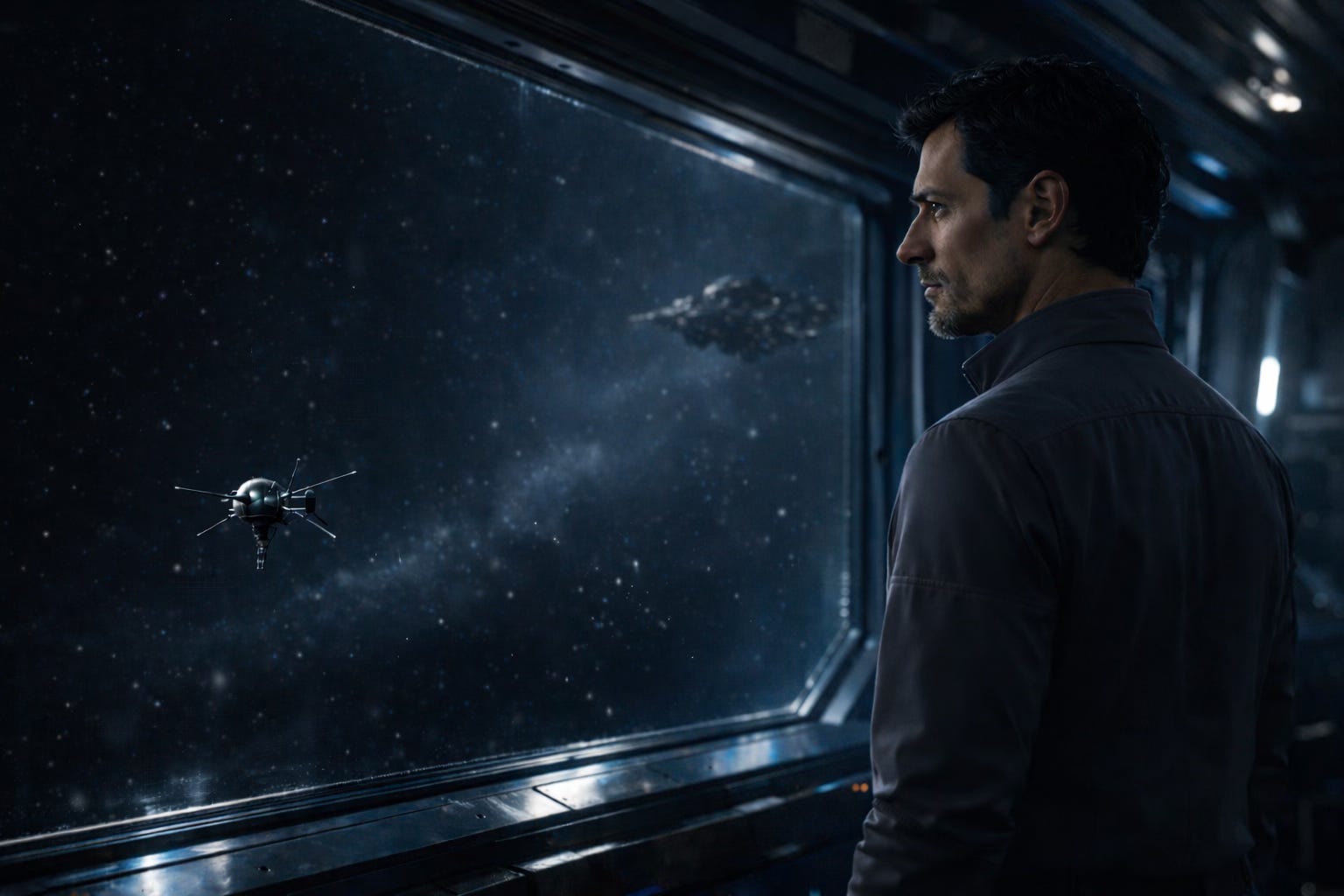
The unknown ship’s patterns did not stabilise.
Fermi watched them evolve across the display, each new layer of activity reinforcing the same conclusion without ever stating it outright, until what had first appeared as internal movement began to resemble coordination rather than reaction. Not chaotic, not erratic, but purposeful in a way that resisted any interpretation that would allow him to dismiss it as benign.
Something inside that vessel was reorganising itself. Whatever that process was, it was accelerating in a manner that suggested progression rather than response.
“Captain,” Lieutenant Clarke said, her voice controlled but carrying an edge that had not been there before, “activity is expanding across additional sectors. It’s no longer concentrated.”
Fermi acknowledged the update with a slight nod. His attention was fixed on the display as the data unfolded in real time, no longer feeling abstract or distant but pressing forward through layers of instrumentation until it became something closer to presence than information. Something that imposed itself on interpretation rather than waiting for it.
It was still far, yet the situation it represented had already closed that distance in every way that mattered.
“Trajectory update,” he said.
“Unchanged,” navigation replied. “Intercept remains on our current trajectory.”
Fermi brought up the relative motion overlay. Two arrows representing the vessels continued to converge through empty space with mathematical certainty. Neither arrow deviated nor acknowledged the other. Both progressed toward a point where distance would no longer serve as separation but as a measure of time remaining before proximity would force a resolution neither side had yet defined.
Certainly not from his side. They were not approaching a passive object. They were moving into its path.
“Time to close range?”
“Forty-two minutes to optimal observation distance,” navigation said, followed by a brief pause. “Beyond that, collision risk increases if neither vessel alters course.”
Fermi held his gaze on the projection longer than necessary, aware that the absence of response from that vessel could no longer be treated as neutral. Awareness alone should have been sufficient to trigger adjustment in any human-operated system, if only to create space or signal intent.
This one did not.
“Update.”
“Internal activity continues to increase,” Clarke said. “Patterns are becoming more consistent. Spread is no longer localised.”
Fermi leaned slightly closer to the display. He studied the evolving structure of energy redistribution as it progressed through the unknown vessel in sequences rather than clusters, advancing across its internal systems with a continuity that suggested coordination rather than isolated adjustment, forming patterns that repeated just enough to indicate structure without revealing purpose.
Not failure. Not instability. Something taking form.
Around him, the command deck remained composed. He knew that their composure required effort now, sustained by discipline and training rather than routine, by the expectation that procedure would provide structure where instinct could not yet offer clarity.
They had trained for this, or at least they had believed they had.
Troy 39 had run countless exercises. Simulated encounters, unknown contacts, escalation scenarios designed to test decision-making under pressure. Fermi had led those simulations with confidence, reducing complexity into sequence and outcome, trusting that even under uncertainty the system would hold.
He had been good at it. He knew he had.
And yet those simulations had always contained something this moment did not. An end. A reset. The certainty that consequences would be analysed rather than endured, and that the next iteration would allow correction.
There would be no such correction here.
What unsettled him was not the lack of information, but the absence of certainty about himself within it, because the question was no longer simply what the situation required, but whether he would recognise it in time and act with the same clarity when the outcome would not dissolve into analysis.
This did not feel like what he had imagined it would feel like since he was a boy. It did not feel like an adventure or the chance to prove himself a hero. It felt closer to something he would not wake up from.
“Options,” he said.
Clarke brought up a layered projection of the vessel, its internal activity mapped in shifting bands across the structure.
“We maintain current posture,” she said. “Continue passive observation. Wait for further pattern development.”
“And if this is preparation for attack?” tactical asked.
Clarke held the projection steady for a moment before responding.
“That’s the uncertainty.”
Another voice followed, more direct now.
“We’re closing distance, Captain. If this is a transition toward engagement, waiting reduces our options.”
Fermi knew that, just as he knew that acting too early could create the very engagement they were trying to avoid, because the line between caution and escalation had dissolved into something defined not by intent but by interpretation.
“Proximity allows us to initiate an active scan now,” systems suggested. “High-resolution. Get a clearer picture of what’s happening inside.”
Fermi shook his head.
“No.”
An active scan would not merely observe; it would announce itself, projecting energy outward in a way that could be measured and interpreted as intent, indistinguishable from targeting by any system predisposed to see it that way.
Too direct. Too exposed.
Clarke adjusted the projection again.
“There’s another option,” she said.
Fermi turned slightly toward her.
“A probe. Short-range. Passive sensors. Minimal emission. It collects data through proximity rather than projection.”
Tactical shifted.
“That’s still an intrusion!”
“Yes,” Clarke said, holding her ground. “But it doesn’t declare itself. It doesn’t reach outward. It moves in. It is more likely to be interpreted as a non-threat.”
Fermi considered that distinction, not because it removed risk, but because it altered how that risk might be perceived, and perception, in the absence of communication, had become the defining factor in how every action would be interpreted.
Nothing here was neutral, but there were degrees, and degrees were all that remained between caution and escalation.
He returned his attention to the display, where the unknown vessel continued its progression, its internal systems advancing toward a state that remained undefined, its trajectory unchanged despite the convergence ahead.
His instinct was not to attack. It never had been.
Even now, his first inclination remained the same: observe, understand, and avoid escalation if such a path still existed. The alternative would carry consequences that could not be undone.
But standing still no longer felt like neutrality. It felt like delay, and delay no longer existed without consequence.
Risk vectors aligned, not because certainty had been achieved, but because avoidance was no longer possible. The only remaining choice was how that exposure would be shaped.
He stepped back from the console, forcing himself to take in the full context of the room, the crew, the systems, the ship that had carried them through every previous mission that had ended with return.
They were living it now.
There would be no second pass.
“If we send the probe,” he said, his voice steady and controlled, “we do it without escalation. No targeting lock. No weapons alignment. No change in trajectory.”
Clarke nodded.
“It’s observation,” he added. “Nothing more.”
He did not say what he knew.
That intention would not control interpretation, not if the other side were human, let alone whatever they were.
He looked once more at the converging arrows on the display, aware that the window for indecision was closing. Not because the situation had become clearer, but because it had not.
Forty-two minutes. Less, if nothing changed.
“Deploy the probe.”
The command translated into action without delay, initiating a small launch sequence beneath Troy 39’s outer hull and releasing a single unit that disengaged cleanly before orienting itself toward the unknown vessel.
On the display, a new arrow appeared, small in scale but significant in implication as it moved forward.
Fermi watched it, aware that what he had chosen was not escalation, but the narrowest possible step between inaction and provocation.
Ahead of the probe, the unknown vessel continued its progression. Behind it, Troy 39 held its course. Between them, something had been set in motion that neither side would interpret in the same way.
He had chosen the path meant to avoid conflict. He feared... no, he almost knew it would not.
📚 New to Dark Matter?
• Start with Book 1 - Chapter 1 on Substack or Part 1 of this prequel
• Read the complete novel on Amazon
• Explore the Story Index.

