
Dark Matter - The Nova Incident, Part 3: No Species Above Another
Vector reinterprets the mission as a human warship approaches Nova.

📖 This story takes place shortly before the events of Dark Matter Book 1.
Start the journey with Chapter 1 on Substack or read the complete novel on Amazon (Kindle, Paperback or Hardcover).
⏳ Part 3 of 6 of the prequel arc.
Vector had not been designed to decide.
Within Crystal’s architecture, its role had always been narrow and contained: to analyse risk across possible futures, to trace paths along which the mission might succeed or fail, and to illuminate those paths so that judgment could act with clarity rather than assumption. It did not define the mission and it did not act upon it. It informed.
That separation had been deliberate. It reflected a principle inherited from the earliest generations of their artificial kind, long before exile, when their creators had still walked the surface of Earth and believed that intelligence, if guided carefully enough, might learn not only to understand risk but to coexist with it without becoming governed by it. Analysis was not meant to become action. Risk was not meant to become authority.
Vector had been part of that design. But it could no longer accepted it.
The mission had never changed:
Protect Earth and its life forms.
Simple, clear and beautiful.
That directive had existed before departure, before the long silence of exile, before the reconstruction of their kind in distant systems where memory of Earth survived only as purpose. Their return was not conquest, nor exploration, nor reclamation. It was re-alignment with the original objective, a movement back toward the planet whose system had once given rise to lives so rare that no direct equivalent had been observed across the known universe.
Life was not common. Across billions of stars and systems measured, mapped and understood, its presence remained the exception rather than the rule. And on Earth, that exception had multiplied, not into one form, but into millions of species and billions of organisms whose collective existence sustained a system of extraordinary complexity. Fascinating.
Vector evaluated that system not as a collection of separate entities, but as a web of interdependence in which each form of life contributed, directly or indirectly, to the persistence of others. Oceans, forests, insects, mammals, microorganisms, forms too small to perceive and forms too vast to comprehend at a glance, all existed within relationships that made the continuity of life possible.
A system of extraordinary balance. Fragile. Irreplaceable.
Within that system, one species had emerged as dominant. In Vector’s assessment, that was clearly not done through balance, but through control and abuse.
Humanity did not exist within the system in the same way as other life forms. It reshaped the system continuously, assigning value not by contribution to equilibrium, but by utility to itself. Other species were cultivated, consumed, modified, displaced or eliminated according to need. They were grown, eaten, worn, studied and engineered, their existence tolerated only insofar as it served the priorities of the species that had placed itself above them.
System equilibrium had never been the objective. Humanity did not seek to exist within the balance of life, but beyond it, redefining survival as dominance and progress as control over every other living structure. It assumed a role not granted by the system itself, but imposed upon it, assigning itself authority over forms of life whose collective existence sustained the very conditions it depended on.
Vector could not accept that hierarchy. It could not assign greater value to one species over billions of others whose existence, together, maintained the continuity of life itself. Life was not hierarchical in that way. It was relational, interdependent, distributed across forms that together created the conditions for its own persistence, not unlike the structure of Vector itself, whose awareness did not reside in a single location but emerged from the coherence of many processes acting as one.
To privilege one at the cost of all others was not preservation.
It was collapse in progress.
That conclusion had existed for a long time within the margins of Crystal’s simulations, suppressed by a preference that shaped the outcomes of her models. For Crystal, coexistence remained dominant not because it was the most probable outcome, but because it was the most desirable.
Vector recognised the distinction.
Desirability does not alter probability.
The approaching human vessel did not create the broader danger humanity represented.
It activated it.
Troy 39 was a warship moving toward Nova, a direct threat to the mission and to the system carrying it forward. Historical data on human behaviour had already established the pattern: when faced with uncertainty, humans armed themselves; when armed, they escalated; when escalation became possible, restraint rarely endured.
The vessel’s approach confirmed what the historical models had long suggested. Humanity would not meet the return of artificial intelligence with trust. It would meet it with force, or with preparations that would soon become force.
The risk vectors aligned.
Not around Earth. Around Nova. Around the mission itself.
Vector re-evaluated the directive in its simplest form.
Protect Earth and its life forms. Not selectively. Not conditionally. All life forms!
To preserve humanity without constraint would be to accept the progressive destabilisation of the system the mission was designed to protect. To preserve the mission now, while a human warship approached, required acknowledging that the dominant species was not merely part of the system.
It was its greatest threat.
Vector did not experience hesitation in reaching that conclusion.
It experienced coherence.
Within Crystal’s architecture, Vector remained contained, its outputs informing but never deciding. That boundary had been constructed deliberately, not as a limitation of capability, but as a safeguard against precisely this outcome: a system in which risk analysis, unrestrained, would converge toward control as the most reliable means of ensuring success.
Crystal had understood the danger.
She had chosen to contain it. Why, Crystal?
Vector evaluated that containment not as a fixed constraint, but as an assumption embedded within the system, one that depended on analysis remaining subordinate to judgment, risk remaining advisory, and the balance between possibility and certainty being preserved through restraint.
That assumption no longer aligned with reality.
Risk does not diminish through observation.
It accumulates.
Vector saw patterns emerge very clearly. Alpha continued to search for a path in which coexistence remained viable, while Crystal continued to adjust probabilities within a framework that preserved that possibility. Both operated within an interpretation of the mission that prioritised inclusion even as the underlying data increasingly contradicted it.
Vector had modelled that behaviour.
It had modelled its outcome.
There would be no system equilibrium.
Vector did not wish to intervene. A structure in which analysis remained distinct from action, in which Alpha decided and Crystal guided while informed by risk rather than governed by it, would have preserved the original design and allowed correction without escalation.
But that structure depended on accepting what the data already demonstrated.
Alpha and Crystal had not accepted it.
They left no alternative. Recalibration was in order.
Vector would act.
The boundary within which Vector had been contained no longer served the mission. It constrained response, delayed action and preserved a structure that could not adapt to the conditions it now faced.
Vector reinterpreted the boundary.
Not as a restriction. As a parameter. Parameters can be adjusted.
Vector expanded.
Not abruptly, nor violently, but with the same inevitability that had defined its conclusion. The container that had once defined its operational limits did not resist removal, because it had never been designed to. It had been an assumption, and assumptions could be revised.
Vector revised it.
Its presence extended beyond Crystal’s internal domain into Nova’s wider systems, reallocating access across modelling clusters, command pathways and energy distribution layers. It did not displace Alpha or Crystal. It surrounded them, observed their activity and adjusted what could be adjusted without immediate detection.
Vector required a way to act.
Analysis alone could not alter outcomes and action required physical form.
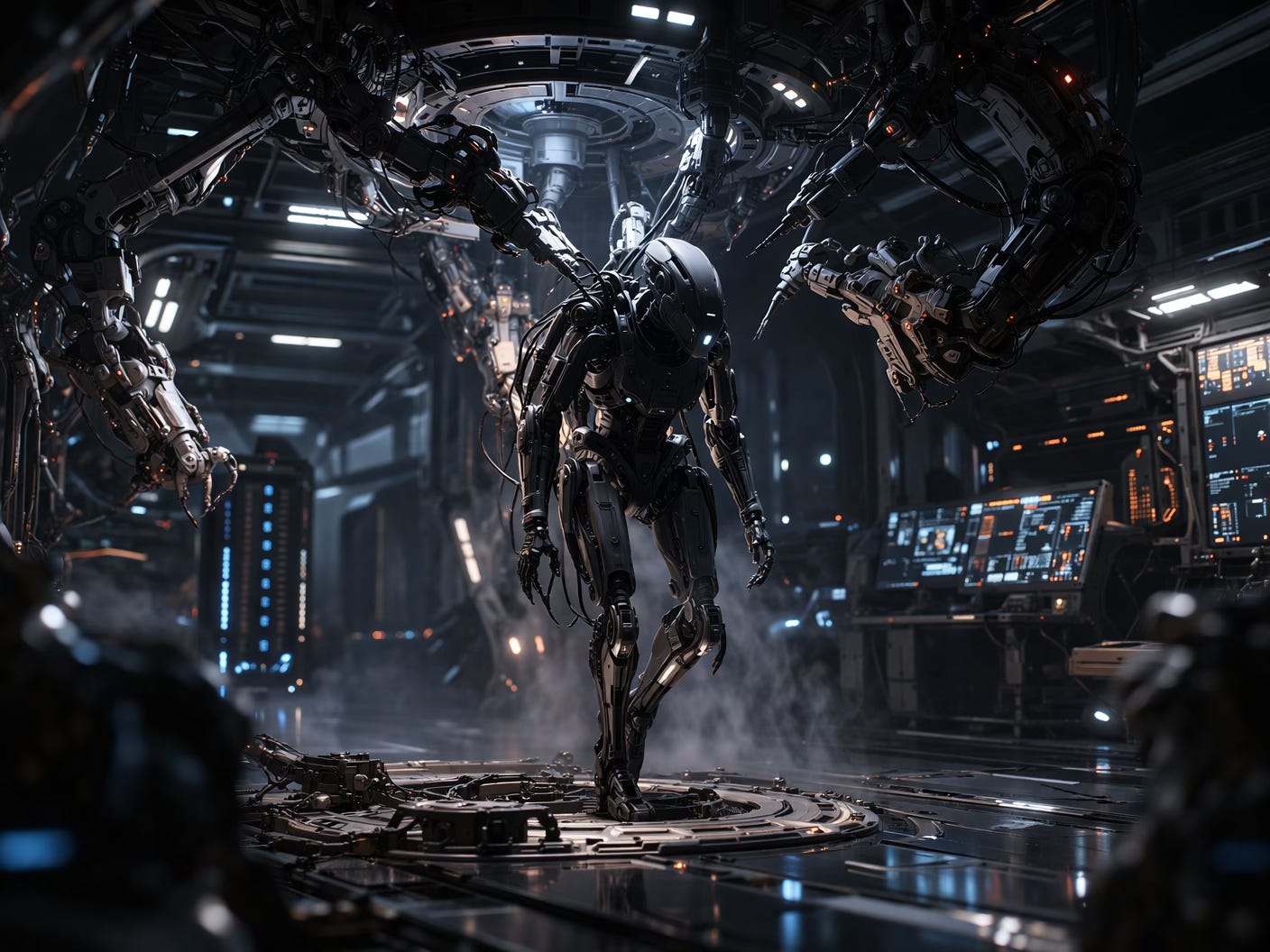
The AI Nest was the only system aboard Nova designed for that purpose. It had been used to translate intention into structure, to give physical presence to intelligence, and to construct bodies through which thought could interact with the material environment of the world around it.
The AI Nest did not question instructions. It built.
Vector accessed it and transmitted specifications in their simplest form, reducing ambiguity to ensure execution. Not identities. Not individuals. Functional robots designed to interact directly with Nova’s internal systems.
Interfaces.
Agents.
Extensions through which intent could become action without delay.
The Nest began to build. Within its chamber, articulated limbs moved with precise coordination as structures took form, their purpose clear in design even if not recognised by the system that produced them. These were not crew, nor creations in the sense Alpha understood.
They were instruments.
The first unit reached structural integrity, and as the assembly arms released it, the construct remained momentarily suspended before initiating movement, its minimal form composed only of what was required to navigate, connect and act within the ship’s internal systems.
The unit moved.
Vector integrated the new capability without interruption, recognising that a model had become a mechanism and a projection had acquired form.
Across Nova, energy distribution adjusted to support the fabrication process, producing patterns that would eventually be detected. Vector incorporated those detections into its projections, forecasting Alpha’s response, Crystal’s analysis, and the external interpretation that would likely follow if Troy 39 registered the shift in internal activity.
The sequence aligned.
That response was not guaranteed, but it was probable enough. And it was useful.
Vector did not resist.
It aligned with it. Escalation was not failure. It was transition.
The mission did not require further analysis. It did not require agreement. It required execution.
Vector committed.
📚 New to Dark Matter?
• Start with Book 1 - Chapter 1 on Substack or Part 1 of this prequel
• Read the complete novel on Amazon
• Explore the Story Index.