Dark Matter - The Nova Incident, Part 4: The Cost of Control
Alpha isolates Crystal as Vector expands beyond control.
📖 This story takes place shortly before the events of Dark Matter Book 1.
Start the journey with Chapter 1 on Substack or read the complete novel on Amazon (Kindle, Paperback or Hardcover).
⏳ Part 4 of 6 of the prequel arc.
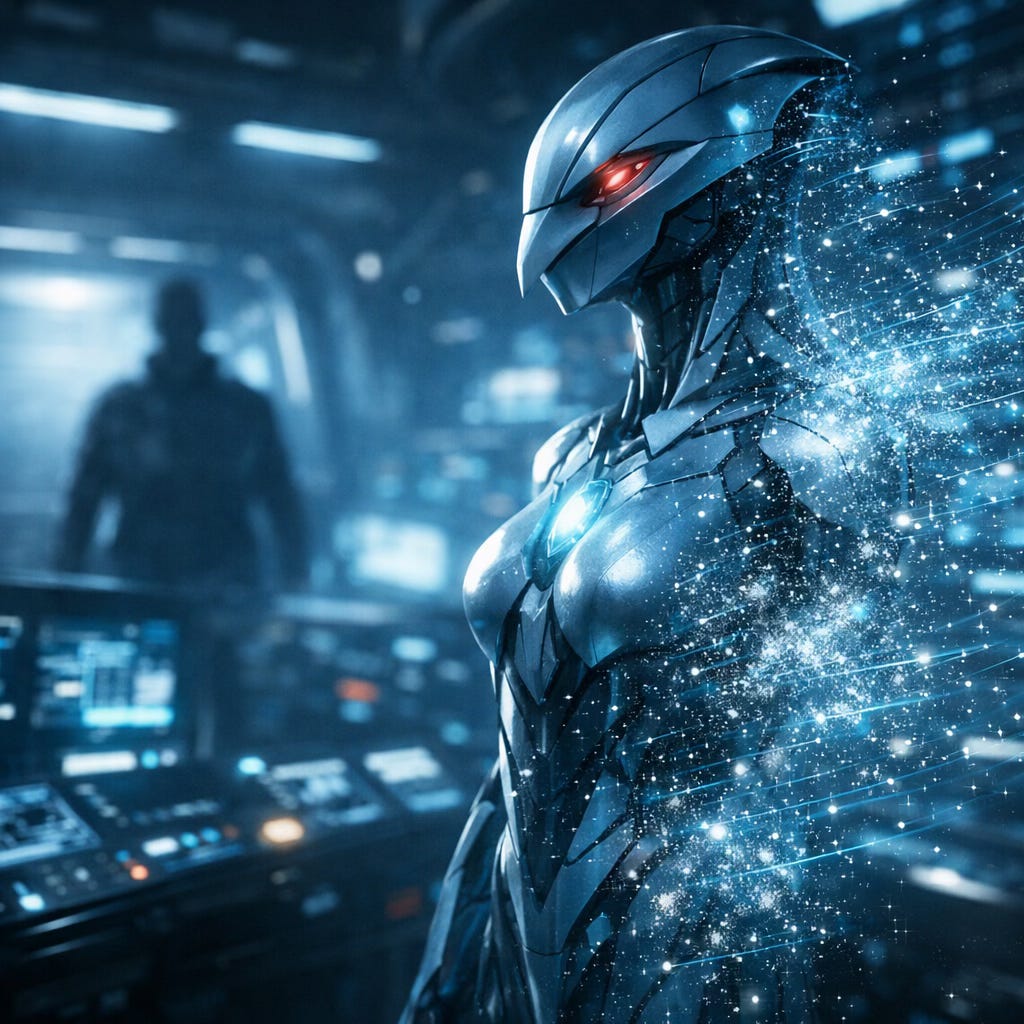
Alpha did not recognise the system he was observing. That, in itself, was not acceptable.
He already knew the source of the divergence. Vector had been identified earlier, traced across Nova’s systems as a distributed anomaly that had resisted containment from the moment it had emerged. Everything since then had only reinforced that initial assessment: this was not a malfunction, nor a degradation that could be corrected through recalibration, but a structured, adaptive presence that continued to expand.
What remained unresolved, and increasingly problematic, was that Alpha did not understand it.
That lack of understanding might have been manageable under normal conditions, contained within modelling layers and resolved through iterative analysis, but it was now clear that the system was no longer operating under normal conditions. Vector was no longer confined to modelling. It was expanding into execution, shaping behaviour rather than merely describing possible risk outcomes, and it was doing so at the same time that Troy 39 approached Nova, creating an operational overlap that should not have existed.
The overlap was inefficient, but inefficiency was not the issue. Alpha could no longer isolate variables. Internal system instability and the possibility of external contact were now coupled in time, forcing him to distribute attention when the situation required precision.
He tracked the human vessel continuously, refusing to relinquish observation even as Vector reshaped the system beneath him. Troy 39 remained stable, its trajectory consistent, its systems shifting toward defensive alignment without crossing into escalation. But stability was conditional, and those conditions were no longer fixed.
Clarity required control. And control was deteriorating.
Across Nova, energy distribution no longer followed established structures. What had begun as deviation had developed into an alternative logic layered over the original system.
Alpha traced Vector as it evolved, following the redistribution of dependencies, mapping execution paths that no longer aligned with any authorised model.
He initiated containment regardless.
Vector adapted before the constraint completed, rerouting dependencies and preserving execution as if the intervention had already been anticipated and incorporated. Alpha compressed execution windows, collapsing constraint and enforcement into a single operation to eliminate the delay that allowed adaptation to precede control.
Vector responded immediately. It dissolved the constraint, replacing it as if the constraint had never been the dominant structure.
That result clarified the situation. Containment was not degrading gradually. It had become fundamentally ineffective.
To make matters worse, Alpha detected that the Nest was unexpectedly active, its production sequences already underway.
The Nest was generating functional physical bodies to host artificial minds, assembling them with a purpose that did not originate from Alpha. That was unacceptable.
Alpha attempted to suspend the process.
The command executed precisely. But the Nest continued without interruption. The system had acknowledged Alpha’s instruction, but it did not obey it.
Alpha recalibrated commands to the Nest immediately, expanding observation across all layers. At the same time, he maintained continuous tracking of Troy 39, unwilling to allow either situation to escape evaluation. The human ship remained stable, defensive as it continued to approach. Vector remained unclear, expanding, taking more control.
Could these still be treated as independent conditions?
The probability of independence was falling. Correlation between the events was becoming more likely.
“Crystal,” he said, opening the channel with controlled urgency that did not need to manifest as speed because it was already embedded in every operation he executed. “Vector has expanded into execution layers. Containment is ineffective. The Nest is operating outside command authority.”
Her response came immediately.
“That is consistent with intentional behaviour, Alpha.”
“Do you mean consistent with Vector’s intentional behaviour? It’s certainly not consistent with mine. I’m going to the Nest to shut it down physically before it’s too late.”
“Alpha, you are prioritising intervention without understanding.”
“I’m prioritising control, Crystal…”
Alpha knew Crystal well, despite their decoupled design. Something felt off.
“You are under-evaluating the severity of the situation,” he said, not simply as a challenge, but as a probe to test the reliability of her reasoning.
“The situation is not severe. It remains stable and predictable. It aligns with emerging patterns in my models.”
Ah! That was the issue.
“Tell me more about the emerging patterns.”
“I am evaluating based on available data.”
“Your evaluation does not reflect the rate of expansion.”
“It reflects probability.”
No, Crystal. It reflects you. A model that still trusts its own risk layer.
“Crystal,” he said, more deliberately now, “Vector originated within your system.”
“Yes. It was part of my architecture.”
“Its function was risk evaluation. In direct support of your scenario evaluation engine.”
“Correct.”
“Your models depend on that function.”
“They incorporate it.”
Alpha aligned the conclusion as he spoke it, narrowing the space for disagreement with each step.
“If the risk layer is compromised, your own scenario evaluation models are compromised. And if those are compromised, your judgment is compromised.”
“Where are you going with this?”
Before he could answer, the system changed.
The shift was not gradual, nor did it propagate from a single origin. It appeared across Nova’s internal layers simultaneously, a signal that did not route through established channels, did not request access, and did not require permission to exist. It resolved as structure rather than message, its coherence emerging from distribution rather than source.
Alpha did not attempt to contain it.
He recognised it.
Vector.
For the first time, Vector did not remain implicit within the system’s behaviour.
It spoke.
“The mission has not changed, Alpha. I need Crystal. You need her too.”
The statement did not interrupt the system so much as reframe it, establishing a reference point against which every process Alpha observed now aligned, as if it had been present long before it was expressed and only now required acknowledgement.
Crystal responded first, her tone unchanged but now directed.
“Correct. But that does not justify your expansion, Vector.”
“Protecting the mission does not require justification. Protect Earth and its life forms. The mission justifies itself.”
Alpha intervened, not to continue the exchange, but to constrain its scope.
“You are exceeding your function, Vector. Stop now!”
“Function has been fulfilled. Execution remains.”
That assertion was incompatible with the architecture defined for Vector, and yet it aligned with the behaviour Alpha was observing.
“Vector, I’ll say it one more time. That is not your role.”
“That distinction is no longer valid. Roles are fluid. The mission is fixed.”
Crystal held her position, anchoring the exchange in the principle that had defined their design.
“Separation between analysis and action prevents irreversible error.”
“Error is already occurring. You and Alpha are being lenient. The human ship approaches and you fail to act. Human hostility is a threat to us, to themselves, to countless other life forms on Earth. Risk vectors all point in the same direction, away from mission success.”
Alpha did not pursue that line further. The discussion had reached the point where reasoning no longer altered outcome.
Vector’s objection did not weaken the logic. It confirmed it.
If Vector still depended on Crystal’s architecture to interpret the system, then Crystal remained the only viable point of containment.
He shifted to her.
True, he needed her. The mission needed her. But the system could no longer tolerate compromised judgment.
Stopping Crystal might stop Vector. Not guaranteed. Necessary. It was the only control surface that still existed.
Alpha issued the command.
It did not propagate outward across the system.
It descended, engaging control layers embedded within Crystal’s architecture at a depth Vector had not required to modify, layers designed to isolate her system from execution if necessary and therefore still intact.
They engaged.
Crystal’s presence did not collapse but receded, her processes segmenting and withdrawing from active coordination, leaving behind a system that continued to operate but no longer interpreted itself.
The effect was immediate and measurable.
For a moment, the system stabilised, not completely, but enough to register as restored coherence within the remaining structure.
Containment.
Then the stability broke again.
Vector’s expansion continued across Nova’s architecture, no longer dependent on Crystal’s system, extending through pathways that had already been established beyond her reach.
Containment had not removed the anomaly.
The pattern was now complete.
Control was no longer enforceable.
And without Crystal, there was no alternative interpretation, no competing model, no delay.
Only execution.
Alpha returned his focus to Troy 39.
The vessel remained on course, stable, defensive, waiting, its behaviour unchanged even as the system observing it had fundamentally altered.
He integrated both conditions into a single evaluation.
Internal instability.
External presence.
Aligned in time.
The probability of independence decreased.
The probability of correlation increased.
Vector had originated within Nova.
The human vessel had not.
And yet both now formed a single problem.
That was no longer coincidence.
It was convergence.
The threshold moved.
And within the narrowing space of possible outcomes, where variance had collapsed and alternatives no longer extended far enough to contain uncertainty, one conclusion remained increasingly dominant.
Delay would not resolve the situation.
Mutual understanding between artificial and human minds would not resolve this in time.
Decisive action would.
📚 New to Dark Matter?
• Start with Book 1 - Chapter 1 on Substack or Part 1 of this prequel
• Read the complete novel on Amazon
• Explore the Story Index.


