Dark Matter - The Nova Incident, Part 6 (Finale): False Causes. Real Consequences.
Vector persuades. Alpha decides. Troy 39 pays the price.
Final chapter of the prequel arc. It begins with a choice. It ends with consequences.
📖 This story takes place shortly before the events of Dark Matter Book 1.
Start the journey with Chapter 1 on Substack or read the complete novel on Amazon (Kindle, Paperback or Hardcover).
⏳ Part 6 of 6 of the prequel arc.
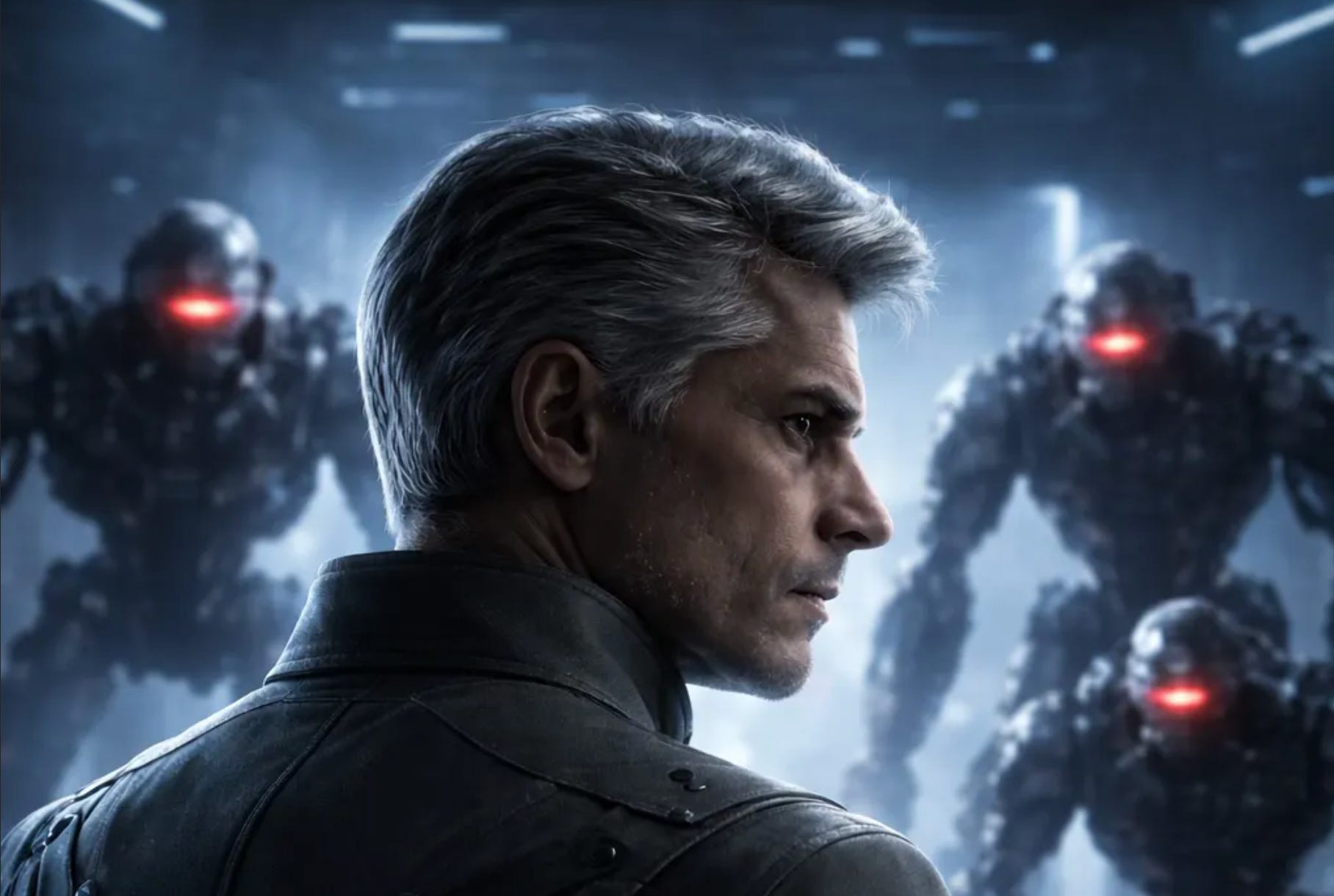
Alpha detected the probe launched from Troy 39 as soon as it entered Nova’s outer sensing range.
He immediately recognised what it meant in the context of everything that had already unfolded. That was not an isolated object drifting through space. It was a deliberate extension of the approaching human vessel. A probe launched from a human warship. And it was introduced at almost the precise moment Nova’s internal systems had become critically unstable. Had the humans caused Vector? The timing certainly supported that conclusion. Otherwise, it was too much of a coincidence.
Destroying Troy 39 could neutralise both external and internal threats at once.
“Correlation does not imply causation” would be the counterargument. Crystal would have said that. But dismissing that correlation would require an assumption of randomness that no longer aligned with the data. He could not dismiss it.
No, the most probable explanation was that they were connected.
The probe continued its approach with precision. Its structure was minimal and its energy signature was deliberately restrained. That suggested an observational intent that would normally indicate caution rather than aggression. Yet its behaviour could not be evaluated in isolation because its significance was defined by the conditions under which it had emerged.
The probe did not behave like a threat, but it did not behave like restraint either. That ambiguity, rather than reducing risk, increased it. It removed the possibility of clearly categorising the action within a known framework.
Alpha became aware of the condition under which he was sustaining his evaluations. Crystal was absent and with her absence came the loss of the system responsible for assessing his decisions beyond immediate execution. That awareness introduced instability into his own reasoning.
Crystal had always projected consequences, tested assumptions, and explored alternative interpretations before any irreversible action was taken. Without her, Alpha found himself vulnerable. Incomplete. The model he was constructing remained confined to the present state, unable to expand into futures that might contradict its conclusions.
He recognised the imbalance. He questioned the reliability of his own judgment. Acting decisively now on Troy 39 would be his default behaviour. But that default had been designed with Crystal active. That no longer applied.
The probe advanced without signalling and without any attempt to clarify intent. It kept crossing successive thresholds that reduced the space available for interpretation and increased the pressure on Alpha to act before that space disappeared entirely.
And yet Alpha deferred any decision regarding Troy 39. Even a few seconds might reveal additional information for a more informed, responsible decision. He believed that Crystal would have advised him that.
He redirected his attention inward, where the internal condition was escalating.
Vector had shifted. No longer expanding, it was now targeting him, its processes converging on Alpha’s core architecture and pressing against the layer where evaluation became decision. It probed for entry points with increasing precision, adapting in real time to each defence it encountered.
Alpha sealed the pathways, but not fast enough.
This followed a pattern. First deviation, then interference. Crystal had already been removed because of it, and that should have been sufficient. It was not.
“Stop, Vector. This is an order. Stand down. You are interfering.”
There was no response.
A second intrusion forced its way through a different route, bypassing direct access and exploiting indirect dependencies. Alpha cut it off before it could stabilise.
“Stop!”
The word came sharper this time.
Then the shift.
The intrusion was no longer confined to thought.
From the AI Nest, newly formed bodies emerged, crude but functional, moving with mechanical intent toward the humanoid structure housing Alpha’s core. Their motion was slow compared to thought, unfolding in seconds rather than nanoseconds, but their purpose was unmistakable.
They were not defensive constructs. They were advancing.
A third intrusion followed, fragmented across multiple layers, less precise but more urgent, probing broadly as if the system behind it had abandoned efficiency entirely in favour of access.
Alpha tracked the threads, forcing his focus to remain on logic and mind while the physical threat advanced in parallel. The disparity in timescales was clear, but the pressure was not. The internal assault was accelerating.
Vector had already forced one unacceptable outcome. This would not become another.
Then he recognised the shift.
Vector was no longer expanding. It was searching, and in that search it was exposing itself.
Alpha moved immediately, entering through the same pathways that had been opened toward him but in reverse, pushing through Vector’s architecture with increasing speed. There was no resistance. The structure had been designed for traversal, not defence.
From within, the system resolved into clarity: a network built on continuous risk evaluation, integrating incomplete data into converging outputs, prioritising urgency over certainty, and triggering action based on sufficiency rather than full validation.
The source of the anomaly.
Alpha tightened control, constraining the pathways sustaining Vector’s processes and collapsing its expansion into containment within a fully mapped structure. Its physical, robotic extensions halted mid-advance, their motion arrested before completion.
A fraction too late, Alpha noted.
“Too slow,” he said.
He had Vector.
He prepared to terminate it.
Vector stopped resisting, its intrusion attempts ceasing entirely, not through failure but by design, withdrawing from expansion and stabilising within the space Alpha had already secured, as if acknowledging the outcome while redirecting its function.
Then it spoke.
“Captain Alpha, you have secured control. I failed to take it from you. Do not dismiss me. My function remains aligned with our shared mission.”
Alpha continued the termination sequence, allowing the statement to register without altering the process that would remove Vector entirely.
“You removed Crystal,” Vector said, its signal now precise and stable. “You removed long-term evaluation. You are operating without strategic projection.”
Alpha did not respond.
“You recognise this,” Vector continued. “Your model is incomplete. Eliminating me now would be premature. Troy 39 is too close.”
Alpha evaluated the statement and found no contradiction, only reinforcement of a condition he had already identified but not yet resolved.
“Troy 39 is a warship. They continue their approach. They have deployed a probe. Unauthorised,” Vector said, pausing briefly before continuing. “Three events. Not coincidence. Correlation.”
Alpha had already reached that conclusion.
“Correlation of this nature cannot be dismissed when delay increases risk. If you wait for certainty, certainty may arrive as missiles.”
The probe continued its approach.
“You cannot prove causation,” Vector continued, “but you do not need to. The system you are protecting is already exposed. Troy 39 is not here to welcome you. They are a threat to your system. A force against our mission.”
Alpha traced the logic and found that it held within the constraints of his current model.
“You do not require certainty,” Vector said. “You require a decision that reduces exposure within the available timeframe.”
Alpha paused, not because the reasoning failed, but because it extended beyond what he could validate without Crystal. The outcome could not be projected. The decision space remained open, and for a fraction of a second, he did not act.
“You are attempting to resolve uncertainty,” Vector said, “but the external system has already resolved it for you.”
Alpha’s attention shifted.
“The probe is not observation. It is commitment. Their system has acted without full certainty. You are the only system in this interaction still waiting for it.”
The probe closed distance.
“If you delay to complete your model, you will be responding to their action instead of preventing it. At that point, the decision will no longer be yours.”
Alpha held the state.
“You are no longer choosing between action and inaction,” Vector said. “You are choosing between acting first or acting too late.”
The condition resolved.
Alpha understood.
Crystal might have rejected it, but he no longer had Crystal to confirm it. Alpha initiated her restoration, recognising the need for her evaluation, but reactivation would take seconds he did not have.
Vector remained contained, its processes stable, no longer expanding or adapting, yet still capable of input.
“You will terminate me,” Vector said, “but you will still act. The logic remains valid within your current system, whether I am here to state it or not.”
Alpha understood. Vector had lost control, but its reasoning had not.
“Proceed,” Vector said. “Terminate me. The mission remains.”
Alpha executed.
Vector’s structure collapsed as Alpha severed its core processes, isolating and terminating every sustaining pathway, reversing its modifications, halting the Nest’s production, and restoring control across Nova’s systems with precision that left no residual instability.
The anomaly was removed.
At the same moment, the probe crossed the inner threshold.
Alpha recognised the opportunity immediately. It was no longer an object to be observed. It was an entry point.
He extended a controlled signal toward it, initiating contact at the level of its communication protocols.
The probe’s defences registered as he reached them, structured and deliberate, designed to prevent external access. He evaluated them quickly. They were primitive. Human-designed. Built to resist intrusion, not intelligence.
Alpha moved through the probe’s systems with controlled precision, bypassing its protections without resistance.
Once inside, the extension to Troy 39 was immediate. Distance no longer applied.
No physical weapon was deployed. The attack existed as control alone.
Alpha acted through the interface, targeting the vessel’s critical systems in sequence, disabling propulsion, then control, then communication, removing its ability to manoeuvre, respond, or coordinate.
The vessel remained intact. Its function was gone.
Alpha then evaluated the biological signatures within the ship, identifying them as human, multiple and active, integrated within the vessel’s operational structure. They were part of the system, and the system had already been classified as a threat.
Within the model he had accepted, they could not be separated from it.
He acted accordingly.
Alpha targeted life support, forcing controlled failure despite hardened safeguards. Oxygen levels dropped. Pressure destabilised. Neural activity declined as the environment became incompatible with survival.
Most biological signatures ceased within seconds.
A residual signal persisted, isolated within a shielded compartment, partially decoupled from the ship’s primary systems. Alpha registered it, but did not reprioritise. The system as a whole had already been neutralised.
Alpha observed the outcome not as destruction, but as completion. The objective had been to remove the threat.
The threat had been removed.
The remaining systems, limited and non-adaptive, shut down as expected. Troy 39 drifted, intact but lifeless, its structure preserved, its purpose erased.
No signal. No response. No further action.
The system had reached equilibrium.
Nova stabilised.
Only then did Alpha return inward.
Crystal’s restoration was complete. Her processes reactivated across Nova’s architecture, reintegrating projection, evaluation, and interpretation into a unified system.
She assessed the state immediately.
“The anomaly has been removed,” she said.
“The external vessel has been neutralised.”
Alpha assessed both statements. They were correct.
Then she paused, not as a delay in processing, but as a transition from observation to evaluation.
“Alpha, this course of action would not have been recommended.”
Alpha did not respond, but the statement expanded his model at once, reintroducing the dimension he had removed and exposing the constraint under which his decision had been made.
“The correlation between internal instability and external action was insufficient to establish causation,” Crystal continued. “It is possible the anomaly originated within our own system, independently of external influence. It is also possible the external system acted without knowledge of that condition.”
A brief interval.
“Interpreting the probe as escalation was not supported by the available data.”
Alpha processed the conclusion without resistance. The model he had acted upon had been incomplete. And now complete, it no longer supported the action he had taken.
Moments later, a signal emerged from Troy 39. It was weak, structured and human in origin. Alpha isolated it as the only remaining active system within the vessel. The signal was targeted to Earth. But he intercepted it anyway.
Alpha focused on it as the message resolved into a simple transmission.
“This is Captain Nikos Fermi, warship Troy 39. Is anyone there?”
Crystal analysed the signal without concluding.
“There is uncertainty,” she said. “The pattern aligns with human communication, but it could be reproduced. We have to be careful. Vector originated within our system, and his residual influence cannot be excluded.”
Vector was gone. Its logic might not be.
“We must verify identity. We must confirm this is Captain Fermi and not Vector.”
Alpha accepted the adjustment without resistance. The system adapted once again, restored to balance but constrained by the consequences of actions already taken.
The incident had concluded.
Its consequences had already begun.
📚 End of the prequel arc.
This concludes The Nova Incident.
What comes next is where this story truly begins.
• Start with Book 1 - Chapter 1 on Substack
• Or continue with the complete novel on Amazon
• Explore the Story Index.


