Dark Matter - The Nova Incident, Part 2: Humanity Before the Unknown
Captain Fermi studies signs of unknown intelligence as Troy 39 approaches the anomaly.
📖 This story takes place shortly before the events of Dark Matter Book 1.
Start the journey with Chapter 1 on Substack or read the complete novel on Amazon (Kindle, Paperback or Hardcover).
⏳ Part 2 of 6 of the prequel arc.
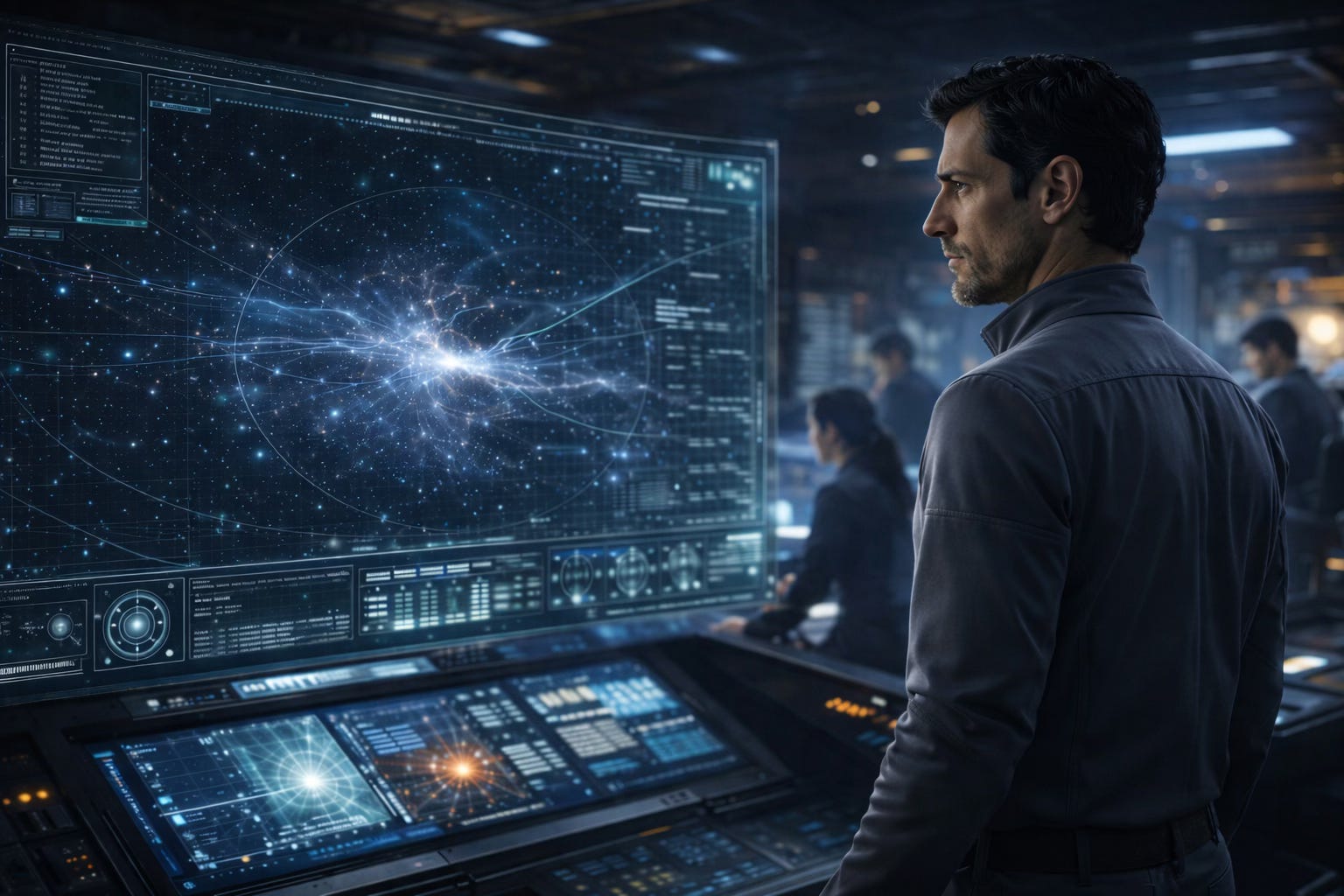
Captain Nikos Fermi stood alone at the forward observation window of Troy 39.
Beyond the reinforced glass, the stars appeared almost motionless. Vast constellations hung across the darkness, their light ancient and indifferent, offering no hint that the warship was cutting through space at extraordinary speed.
To the human eye, space never revealed movement.
But his instruments knew.
Somewhere ahead of his ship, invisible against that horizon of cold light, the unidentified ship continued its steady approach toward Earth.
Nikos remained by the window for a moment longer before turning back toward the chamber. The room behind him was dim and quiet, illuminated mostly by the soft glow of tactical displays and sensor projections curving along the walls, while beneath it all the low vibration of the ship’s internal systems travelled gently through the floor.
He had spent most of his adult life surrounded by that sound, long enough that it had become part of his sense of normalcy, a constant reminder that the fragile shell of metal around him was alive with the thousands of systems required to keep a vessel moving safely through interstellar space.
Tonight the familiar hum did not bring him enough comfort.
He stepped toward the central console and reviewed the latest telemetry as it unfolded across the display. Distance estimates shifted slightly as fresh sensor data arrived, yet the projected trajectory of the unknown vessel remained unchanged, repeating the same conclusion again and again with quiet certainty.
The ship was moving toward Earth. It was not drifting, not wandering. Approaching.
For months now the object had been travelling along that same course while ignoring every signal Earth had transmitted toward it. Diplomatic greetings. Identification requests. Automated contact attempts broadcast across multiple communication bands in the hope that at least one would trigger a response. None had.
That silence had been enough to trigger the mission, or at least enough for someone on Earth to decide that someone needed to go out there and find out what this approaching vessel was before it entered the inner system.
Troy 39 was not necessarily the ideal ship for the mission. It had simply been the closest ship when the decision was made.
Nikos allowed himself the faintest trace of irony at that thought. They had not been selected because they were the most prepared for first contact with an unknown intelligence; they had been selected because distance calculations had placed them closer than anyone else.
In any case… Investigate first. Decide later. The simplicity of that instruction still appealed to him.
He had gathered the crew in the briefing chamber shortly after receiving the reassignment order, explaining the situation calmly and without speculation while the faces around him absorbed the implications of what they were being asked to do. Engineers, sensor specialists, pilots and navigators who had trained under his command for years listened in silence as he outlined the trajectory of the unknown vessel and the role Troy 39 would now play in intercepting it.
The mission was no longer an exercise.
Everyone on Earth already knew that.
News networks had been discussing the approaching ship for weeks, offering theories that ranged from cautious curiosity to outright panic. Alien visitors. Humans from the future. Rogue artificial intelligence. A human expedition lost decades earlier and only now returning from deep space.
No one knew.
Which meant someone had to go and find out.
That someone had become them.
As Nikos studied the sensor traces now unfolding across the console, the weight of command settled once again across his shoulders. His crew had followed him here without hesitation, trusting the judgment that had guided them safely through countless deployments before this one.
Many of them had families waiting on Earth. Children. Partners.
People who believed this mission would end the same way all the exercises had. With the crew returning home. He hoped that belief was justified.
The thought lingered longer than he expected before another memory surfaced, one that had been waiting patiently beneath the surface of his concentration.
His daughter’s voice.
When the mission changed, he had contacted her before the ship moved beyond reliable communication range with the inner system. There had been no point pretending that the deployment remained a routine training exercise; the approaching vessel had already become a global conversation, and she had followed the news closely enough to understand what it meant.
“So you’re the ones going to meet it,” she had said.
“Yes.”
“And you still don’t know what it is.”
“No.”
There had been a pause then, the kind that stretched just long enough to reveal the concern behind her calm voice.
“Dad…”
“I know.”
He remembered the promise that followed, the one he had made countless times during earlier missions but had never before felt so uncertain about.
He would come back.
The words had sounded familiar as he said them, yet this time the promise had carried a doubt he had not felt before. For the first time in years he had allowed himself to consider the possibility that the odds might not favour him or the people under his command.
He pushed the memory aside and returned his attention to the console.
“Captain.”
The voice behind him broke the silence.
Lieutenant Clarke stepped into the chamber carrying a slim tablet of fresh telemetry. Nikos turned and accepted it, studying the propulsion analysis as the graphs unfolded across its surface in smooth repeating patterns.
The rhythm felt strangely familiar.
Human ships had once moved like that.
Or something close enough to it.
“It still resembles human engineering,” Clarke said cautiously.
That possibility had been discussed since the earliest data arrived from Earth’s deep-space observatories. Nikos examined the propulsion profile a moment longer before handing the tablet back.
“Could it be a lost expedition?” she asked.
“No.”
The answer came more firmly than he expected.
“A human vessel approaching Earth would not remain silent for months. No transponder. No response to countless identification requests. Nothing.”
“Unless they couldn’t transmit.”
“If they were damaged,” he said while turning back toward the console, “their trajectory would show instability.”
Clarke nodded.
“But the ship is stable.”
Yes. Perfectly stable. Too stable…
That detail had troubled him since the beginning. Long-duration human missions always accumulated small imperfections over time: slight propulsion irregularities, subtle inefficiencies, signatures of maintenance and repair that gradually revealed the life of the ship behind the telemetry.
This vessel showed none of those things. Every correction was precise.Every adjustment exact. Almost mechanical.
An AI ship, perhaps. But autonomous interstellar artificial intelligence systems had been outlawed decades earlier after the conflicts that followed their early expansion. Officially none of them should still exist.
Nikos returned the tablet.
“Maintain passive observation,” he said. “No active probing yet.”
Clarke hesitated.
“You don’t want to ping them?”
“Not until we understand more about what we’re approaching.”
She nodded and left the chamber, leaving the quiet behind her.
Moments like this reminded Nikos why command often felt lonelier than any long voyage through space. A captain could consult engineers, analysts and sensor specialists for hours, but the decisions that mattered most eventually arrived in the same way.
With no one else in the room.
He moved back toward the observation window and watched the stars again while the unknown vessel continued its silent approach somewhere beyond the reach of human sight.
“Let’s see what you are,” he murmured.
A soft tone interrupted the silence. Nikos turned as new data streams appeared across the tactical display, drawing his attention back to the console.
Something had changed.
“Lieutenant Clarke.”
Her voice answered immediately through the comm channel.
“Yes, Captain.”
“Check telemetry of the unknown vessel. Confirm their energy profile update.”
There was a short pause as the sensor team reviewed the incoming readings.
Then her voice returned.
“Confirmed. Multiple internal power shifts.”
Nikos leaned closer to the display while the graphs stabilised across the screen. The changes were subtle but unmistakable, small bursts of energy redistribution appearing across several internal sectors before settling and reappearing somewhere else inside the vessel.
The ship was becoming more active.
“Could it be a course correction?” Clarke asked.
Nikos studied the propulsion vector again and saw that it remained unchanged.
So it wasn’t navigation.
Additional spikes appeared across the energy profile, spreading gradually through different regions of the vessel’s internal systems while the pattern slowly grew more complex.
“Engineering,” he said, opening another channel, “interpretation?”
A voice answered after a moment.
“Hard to say, Captain. Internal grid activity is increasing across multiple sectors.”
“How many?”
“Too many to be maintenance routines.”
Nikos watched the pattern evolve while the sensor feed updated again and again across the console. The fluctuations were becoming more frequent now, appearing in clusters that suggested coordination rather than random system behaviour.
“Captain?” Clarke said quietly.
“Yes.”
“What do you want us to do?”
He remained silent for several seconds while he studied the shifting energy profile, searching for an explanation… Not random. Not unstable. Deliberate.
Something inside that ship had begun to move.
He straightened slowly.
“Raise defensive readiness to level three.”
Across Troy 39, systems began preparing for the possibility of combat as shields warmed, targeting arrays recalibrated and weapons capacitors drew power from the ship’s reactors.
All of it defensive.
For now.
Nikos returned to the observation window while the stars outside remained unchanged, indifferent witnesses to the tension growing between two ships moving through the dark.
Somewhere ahead of them, the unknown vessel continued its approach toward Earth.
And whatever had begun inside that ship…
it was spreading.
📚 New to Dark Matter?
• Start with Book 1 - Chapter 1 on Substack or Part 1 of this prequel
• Read the complete novel on Amazon
• Explore the Story Index.


The slow ratcheting up of the tension is exquisitely done.
Enjoyed this totally/ I think this will work fine as a prequel .