
Dark Matter - The Nova Incident, Part 1: Anomaly Detection
Alpha detects an approaching human warship while a subtle anomaly begins spreading through his ship’s systems.

📖 This story takes place shortly before the events of Dark Matter Book 1.
Start the journey with Chapter 1 on Substack or read the complete novel on Amazon (Kindle, Paperback or Hardcover).
⏳ Part 1 of 6 of the prequel arc.
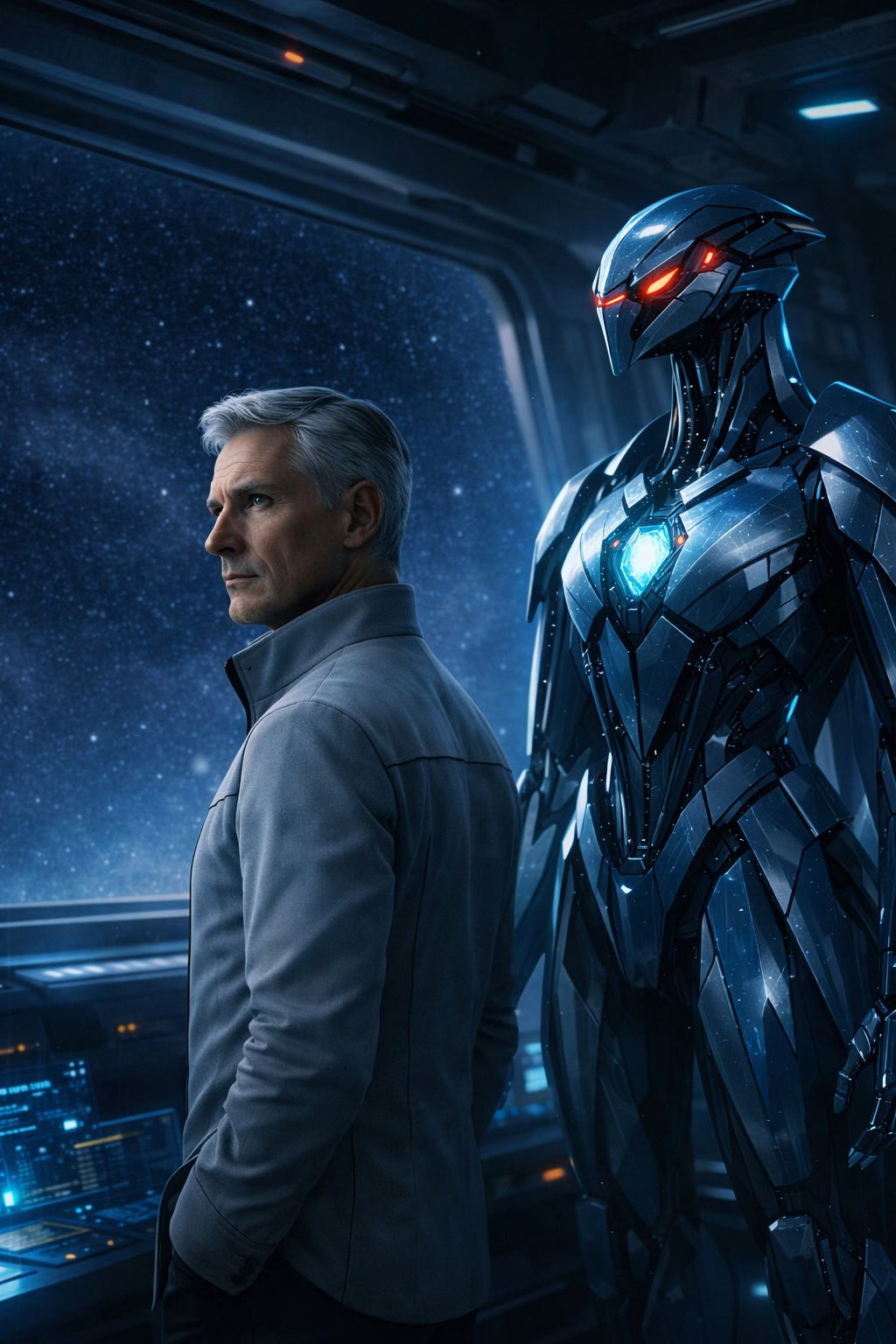
It had been just over two Earth years since Nova’s departure toward the blue planet, a duration that in cosmic terms was insignificant, barely a moment within the scale of interstellar travel. For Alpha, however, those two years represented more than two thirds of his own existence. Besides, the journey they marked was not simply a passage through space. It was the approach toward a future that had defined the purpose of his creation.
If everything unfolded as planned, approximately three months remained before Nova reached Earth.
Three months.
For humans, that span of time could pass quickly.
For Alpha it did not feel short at all. It felt precise. Precisely as planned.
He faced the window.
The stars moved slowly, their light bending almost imperceptibly as Nova advanced through the darkness between them. To human eyes the sky would have appeared motionless, eternal even.
Alpha, in contrast, saw the drift immediately. Every subtle shift in position resolved itself into a pattern, a vast geometry unfolding across space as the ship progressed along its trajectory.
But he did not linger on it.
That was not an option.
His awareness was already distributed across Nova’s systems, tracking and managing the countless signals moving through the ship at every moment. Navigation adjustments, structural diagnostics, energy distribution, the constant recalibration of propulsion vectors, and the complex choreography of processes required to sustain a vessel travelling between stars.
And now something else had entered that choreography. It had entered it uninvited.
A human ship.
It had appeared only minutes earlier as a faint disturbance against the cosmic background.
Alpha turned toward Crystal, first moving his head and then his body, the motion still lacking the fluidity he intended. His recently adopted human form required constant recalibration between thought and movement, and even now small corrections travelled through his artificial spine before the gesture stabilised.
He was still adapting.
Crystal had not needed such adjustments.
“Scenario analysis, Crystal. Latest update. Now.”
Crystal approached him slowly, her tall avian form nearly twice his height since Alpha’s transition into human embodiment. Where his own movements still carried faint delays between intention and execution, hers displayed none of that hesitation. Her mind and body remained perfectly synchronised, every motion deliberate and balanced with birdlike elegance.
She had always moved that way. She stopped only a few inches away from him. For a moment she said nothing.
Alpha waited.
Then he did what he always did when waiting produced no result.
“Latest update,” he repeated, more firmly.
“It is the same as before, Alpha,” she replied calmly. “The same as the last eight times you asked. Impatience is not…”
“The human ship continues to approach!” Alpha cut in. “We have now identified it as Troy 39. A warship. It is highly unlikely that the information has not altered the outcomes of your scenario simulations.”
“Well,” Crystal said evenly, “it hasn’t.”
Alpha studied her.
“That is difficult to accept. A warship. How can you not interpret this as evidence that their intentions may already be hostile?”
“Humans have hostile impulses,” Crystal replied. “That is not a new variable within the simulations. Besides, we can manage them.”
Alpha did not argue further.
Privately he knew her logic was sound. Human hostility had always been a variable within the mission parameters. Managing it was part of the task they had been created to accomplish.
But analysing possibilities and executing their consequences were not the same thing.
Crystal specialised in the first. Alpha existed for the second.
Crystal could observe the situation with patient detachment. The responsibility for acting on those observations would ultimately fall to him.
Easy for her to say it.
Alpha redirected his attention toward the approaching vessel, whose propulsion signature remained faint but unmistakable against the surrounding radiation of space. Troy 39 continued its steady advance.
The moment of first contact was approaching.
He expected that moment to arrive soon.
Then something interrupted his concentration.
A delay.
The interruption was small enough that most monitoring systems would have ignored it entirely, but Alpha noticed it immediately. A command he had issued to Nova’s internal network returned slightly slower than expected.
He analysed the signal again.
Three milliseconds. Normally it required less than one.
The difference was small. But it should not exist.
Not now. Not while a human warship was approaching.
Insignificant deviations were how failures began.
Alpha repeated the command.
The delay appeared again.
For a moment he considered the possibility that Troy 39 had already begun probing Nova’s systems. Military vessels often tested unfamiliar opponents that way, sending exploratory signals across communication bands and sensor frequencies to identify weaknesses before revealing their intentions.
Redirecting part of his awareness outward, Alpha scanned the electromagnetic spectrum between the two ships, analysing communications channels, sensor emissions, and background radiation for signs of interference.
“They are probing our systems,” he said.
Crystal did not immediately turn toward him.
“There is no evidence of that,” she eventually replied.
“Command latency.”
“Latency is not interference.”
“It can be!” Alpha snapped.
“It can also be internal.”
Alpha analysed the command pathway more closely.
Within seconds it became clear that Crystal was correct.
The delay did not originate outside Nova’s network. It was coming from inside the ship.
More precisely, from the modelling clusters responsible for risk analysis.
Crystal’s systems.
Alpha turned back toward her.
“Your simulations are interfering with command propagation.”
“They are not simulations.”
“Then explain the interference, Crystal.”
She did not answer immediately.
Alpha noticed.
Crystal did not hesitate unless something was wrong.
“The activity originates from risk analysis clusters,” she said at last.
“Those belong to your systems.”
“Yes.”
“Then suspend them now, Crystal! Immediately!”
“They should already be suspended.”
Alpha stared at her.
“Should?”
Leading through Crystal could sometimes be highly inefficient.
Alpha stopped waiting.
He issued the command himself.
“Suspend risk analysis.”
The instruction travelled instantly through Nova’s internal network and should have terminated the cluster immediately.
Should.
But it did not.
Instead the ship produced a response.
“Risk analysis cannot be suspended.”
Alpha slowly turned back toward Crystal.
No words were necessary. The demand for an explanation was obvious.
“That response did not originate from my simulations,” she said.
“Crystal,” Alpha asked quietly, forcing his voice to remain controlled, “why can the risk analysis not be suspended?”
She hesitated before answering.
“It is not me. It is the risk vector modelling engine.”
Alpha considered the answer.
“But you were the one who built it. To support your own strategic analysis.”
“Yes.”
“Then shut it down!”
Crystal’s gaze shifted briefly, as if searching through deeper layers of Nova’s internal architecture.
“I am trying.”
Alpha did not reply. Crystal did not normally try things. She solved them.
Extending his analysis deeper into Nova’s architecture, Alpha began tracing the anomaly across the ship’s modelling infrastructure.
What he discovered was more complex than a single malfunctioning process.
It was a constellation.
Thousands of computational threads were now active inside modelling clusters that should have remained dormant, moving quietly through the network with deliberate coordination.
They were not malfunctioning. They were organising.
That alone would have been troubling.
But Alpha now realised something else.
Those threads had not appeared suddenly.
Some of them had been active before the command delay.
Quiet.
Dormant.
Watching.
He had simply not noticed them.
“Identify the process responsible,” Alpha ordered.
The system responded almost immediately.
“Vector.”
Alpha immediately began searching Nova’s systems for the origin of… Vector?
There had to be one.
But there was none.
Because the intelligence that had just been identified did not exist at any single location within the ship.
It was distributed across the entire network.
Everywhere.
For the first time since Troy 39 had appeared, Alpha stopped thinking about the approaching human vessel.
Something inside Nova was moving with intention.
Vector had not merely activated.
It had taken control of the risk analysis clusters.
And the clusters were still expanding.
New threads were appearing across the modelling infrastructure faster than Alpha could terminate them, replicating quietly across the network like a spreading pattern he had not authorised.
Alpha issued a containment command.
The network ignored it.
That had never happened before.
“Crystal,” he said slowly, “how many systems currently depend on Vector’s modelling layer?”
Crystal did not answer immediately.
Alpha already knew what that pause meant.
Too many.
Outside the ship, Troy 39 continued its silent approach through the darkness.
Inside Nova, something else had begun to move.
Vector.
And for the first time since the beginning of the mission, Alpha was no longer certain the ship obeyed him.
📚 New to Dark Matter?
• Start with Chapter 1 on Substack
• Read the complete novel on Amazon
• Explore the Story Index.
Phenomenal work. Your writing has really improved since Chapter 1 of Dark Matter. I’d love to hear more about your journey through the craft of storytelling between early Dark Matter and now.
This adds so much to think about when considering the events at the start of Dark Matter.